
The Remote Job Market Is Competitive — Here’s How to Win
Remote job search tips are more in demand than ever, and for good reason. The way people find work has fundamentally shifted.
Quick answer: The most effective remote job search tips in 2025
- Optimize your LinkedIn profile with remote-ready keywords and set your location to signal openness to remote roles
- Use niche remote job boards like We Work Remotely, Remote.co, and Wellfound instead of relying only on LinkedIn or Indeed
- Run Google X-ray searches on ATS platforms like Greenhouse and Lever to find unlisted remote postings
- Tailor every resume to mirror the job description and include proof of remote skills (Slack, Zoom, async work)
- Network directly with hiring managers and recruiters — many remote roles are filled before they’re ever posted publicly
- Verify every job posting to avoid scams, which make up roughly 30% of all remote job listings online
- Follow a consistent weekly routine — aim for 25–40 targeted applications per week and track everything
Here’s the reality: remote roles receive 2–3 times more applications than in-office jobs. At the same time, only about 12% of new job postings in Q2 2025 were fully remote. That’s a lot of people chasing a smaller slice of the pie.
And it gets harder before it gets easier. Over 75% of resumes never reach a human reviewer — they’re filtered out by Applicant Tracking Systems (ATS) long before a recruiter skims your name. When a recruiter does look, you get roughly 7–10 seconds of their attention.
The good news? Most job seekers are making the same avoidable mistakes. That means doing just a few things right puts you well ahead of the crowd.
This guide walks you through exactly what those things are — from optimizing your profile to running advanced searches, building a 90-day plan, and spotting scams before they waste your time.

Optimizing Your Digital Presence for Remote Job Search Tips
In distributed work, your digital presence is your storefront. Because you won’t be walking into an office for an interview, your LinkedIn profile and resume must scream “I am reliable, tech-savvy, and ready to work from anywhere.”
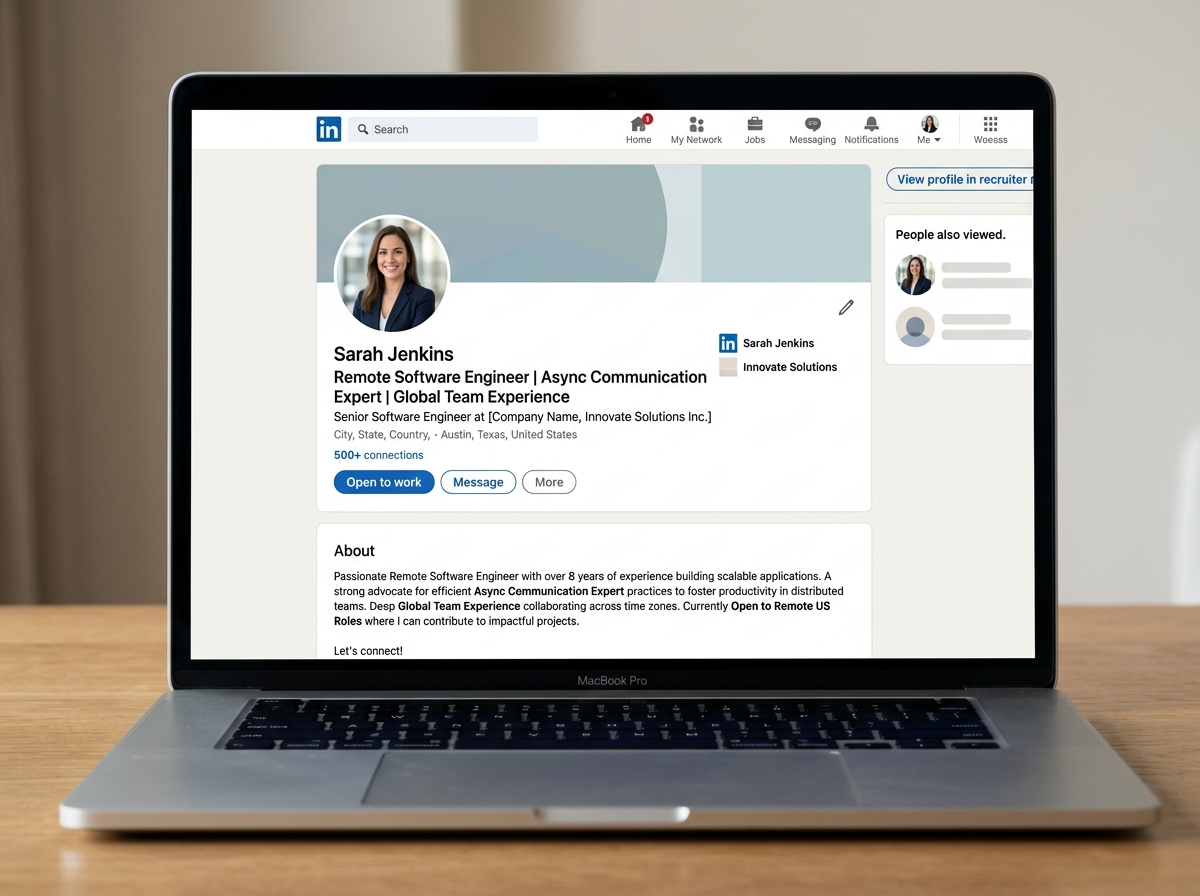
To start, we need to look at how recruiters actually find talent. Most recruiters use LinkedIn Recruiter to filter candidates by location and skills. If your profile isn’t optimized, you are invisible. One of our favorite remote job search tips is to change your LinkedIn location settings. Even if you live in a small town, you can set your “Open to Work” preferences to include major hubs like “United States (Remote)” or specific regions where your target companies are based. This signals to the algorithm that you are a viable candidate for roles that aren’t tied to a physical desk.
We also recommend focusing on “remote-first” signals. This means moving beyond just listing your job titles. You need to explicitly mention your experience with global teams, async communication, and timezone management. If you are just starting out, check out this breaking-into-remote-work-a-beginners-guide to build a solid foundation.
Highlighting “Remote-Ready” Skills on Your Resume
When a recruiter spends only 7 seconds on your resume, they are looking for specific “trust markers.” For remote roles, these markers prove you can function without a manager hovering over your shoulder. We suggest weaving the following skills into your professional summary and bullet points:
- Self-Discipline and Autonomy: Use phrases like “Managed a distributed project pipeline with zero direct supervision.”
- Digital Collaboration Tools: Don’t just list them; show how you used them. For example: “Coordinated 15+ stakeholders via Slack and Zoom to reduce project turnaround by 20%.”
- Asynchronous Communication: Mention your ability to document processes and communicate clearly across time zones.
- Quantified Achievements: Remote companies love data. Instead of saying you “handled sales,” say you “increased remote sales revenue by 42% over 6 months.”
Using LinkedIn Filters as Part of Your Remote Job Search Tips
The standard “Remote” filter on LinkedIn is a good start, but it’s often cluttered with “ghost jobs” or hybrid roles masquerading as fully remote. To get better results, we suggest these specific strategies:
- Work Type Filters: Always toggle the “Remote” button, but also use the “Work Type” filter to select “Contract” if you are open to international roles, as many US/Canada companies hire global talent as contractors first.
- Country-Specific Targeting: If you are outside the US but want a US-based role, search for “Global” or “Worldwide” in the location field alongside your job title.
- Profile Headlines: Your headline shouldn’t just be your current job. Try: “Senior Marketing Manager | Remote-Ready | Global Team Specialist | 10+ Years Experience.”
- Keyword Density: Ensure terms like “distributed teams,” “telecommuting,” and “work-from-home” appear at least 2-3 times in your profile to satisfy the ATS.
Mastering the Technical Search: ATS and Google X-Ray
Most modern remote-first companies and startups don’t use old-school job boards. They use specific Applicant Tracking Systems (ATS) like Greenhouse, Lever, and Ashby. These platforms are where the “hidden job market” lives. Often, a job is posted on the company’s Greenhouse page days before it hits LinkedIn—or it might never hit LinkedIn at all.
To bypass the noise, we need to go straight to the source. If you’re looking for specialized roles, such as sales, you can find a curated ultimate-list-of-flexible-remote-sales-jobs-for-freedom-seekers that targets these high-growth sectors.
Remote Job Board Comparison
| Platform | Best For | Cost | Scam Risk |
|---|---|---|---|
| FlexJobs | Vetted, high-quality listings | Paid | Very Low |
| We Work Remotely | Tech, Marketing, Design | Free | Low |
| Wellfound (AngelList) | Startups and Equity roles | Free | Medium |
| Remote.io | Global tech roles | Free | Low |
| LinkedIn/Indeed | General volume | Free | High |
Advanced Google X-Ray Strings for Remote Job Search Tips
Google X-raying is a technique used by recruiters to find candidates, but you can use it to find jobs. By using “Boolean logic,” you can search the internal career pages of thousands of companies at once.
Try entering these exact strings into Google:
- To find jobs on Greenhouse:
site:jobs.greenhouse.io "Product Manager" AND "Remote" - To find jobs on Lever:
site:jobs.lever.co "Data Analyst" AND "Remote" -hybrid - To find international roles:
site:ashbyhq.com "Software Engineer" AND "Remote" AND "Worldwide"
These searches uncover unlisted postings and direct-to-ATS links, allowing you to apply before the position is flooded with thousands of “Easy Apply” candidates.
The 90-Day Action Plan to Get Hired
Landing a remote job is a marathon, not a sprint. We’ve seen that the most successful candidates follow a structured 90-day roadmap. Treating your job search like a full-time job (or at least a very serious side hustle) is the only way to cut through the 2025 competition.
- Weeks 1-2: The Foundation. Define your target role. Don’t just say “any remote job.” Pick one title. Optimize your LinkedIn and resume. If you need a skills refresh, your-couch-is-the-classroom-for-these-remote-training-opportunities offers great leads on remote-friendly certifications.
- Weeks 3-8: The Volume Phase. Aim for 25–40 targeted applications per week. This isn’t about “Easy Apply” spam. It’s about tailored resumes and short, punchy cover letters.
- Weeks 9-12: The Conversion Phase. This is where interviews start stacking up. Focus on your virtual presence and follow-up strategy.
Tracking and Following Up on Applications
If you aren’t tracking your applications, you’re flying blind. We recommend using a simple spreadsheet or a tool like Huntr to keep tabs on:
- Company Name
- Role Title
- Date Applied
- ATS Link (Greenhouse/Lever)
- Follow-up Date (7-10 days post-application)
The Follow-Up: If you haven’t heard back in a week, send a brief, professional email to the recruiter or hiring manager. A simple “I’m checking in on the status of my application for the [Role] and wanted to reiterate my excitement for [Company’s] mission” can move you to the top of the pile.
The STAR Method: During remote interviews, use the Situation, Task, Action, Result method. For remote roles, always add a “Remote Twist”—explain how you handled a challenge specifically using digital tools or async collaboration.
Avoiding Scams and Identifying Legitimate Opportunities
Unfortunately, as remote work has grown, so have the predators. Roughly 30% of remote job postings are fake, designed to steal your data or trick you into “repayment” schemes.
To stay safe, we follow these verification steps:
- Check the Email Domain: If a “recruiter” contacts you from a @gmail.com or @outlook.com address, it’s almost certainly a scam. Real recruiters use @companyname.com.
- The “Pay to Work” Rule: Legitimate companies will never ask you to pay for your own laptop, software, or “training materials” upfront with a promise of reimbursement.
- Ghost Jobs: If a job has been posted for more than 30 days on LinkedIn, check the company’s actual career page. Many companies forget to take down old ads, or they are “evergreen” posts used just to collect resumes.
- Interview Process: If the entire “interview” happens over a text-based chat like Telegram or WhatsApp without a video call, walk away.
Frequently Asked Questions about Remote Hiring
Which companies hire internationally for remote roles?
Many “global-first” startups and established tech giants hire internationally. Companies like Gitlab, Buffer, Zapier, and Airbnb are famous for their distributed models. However, even if a company is based in the US, they may hire you as an international contractor. We suggest looking for the keyword “Worldwide” or “EMEA/Americas/APAC” in job descriptions to ensure they have the legal infrastructure to pay you across borders.
Is it worth paying for premium job boards?
For many, the answer is yes. Platforms like FlexJobs charge a small fee because they manually vet every single listing. This saves you hours of filtering through scams and “junk” listings on free sites. If you are serious about landing a role in under 90 days, the ROI on a one-month subscription is usually worth the time saved. However, if you are tech-savvy, using Google X-ray on Ashby or Lever is a great free alternative.
How do I stand out without prior remote experience?
Focus on transferable skills. Have you ever worked with a client in a different city? Have you managed a project using Trello or Asana? Have you ever had to solve a problem without a manager present? That is remote experience. Highlight your “proactive communication”—the ability to over-explain your progress so no one has to wonder what you’re doing.
We also recommend building a “proof of work” portfolio. Whether it’s a GitHub repo, a Notion page of writing samples, or a deck of successful sales metrics, showing is always better than telling in a remote interview.
Conclusion
Landing a remote job in 2025 and 2026 requires more than just a “hope and pray” strategy. It requires a technical approach to searching, a marketing approach to your profile, and a disciplined approach to your daily routine. By using these remote job search tips, you stop being a passive applicant and start becoming a strategic candidate that recruiters can’t ignore.
Persistence is the final piece of the puzzle. The market is crowded, but most people give up after the first ten rejections. If you follow the 90-day plan, optimize for ATS, and network with intent, you will find the freedom you’re looking for.
Start your journey to freedom today and take control of your career with FinancePayX.
